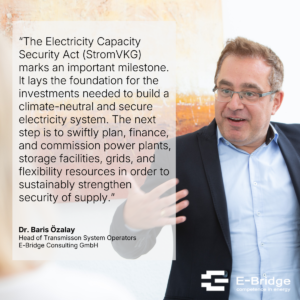

With the adoption of the Electricity Supply Security and Capacity Act (Stromversorgungssicherheits- und Kapazitätsgesetz, StromVKG), an important milestone has been reached for Germany’s future security of electricity supply. The real challenge now lies in its practical implementation.
After many years of intensive discussions, the StromVKG provides the regulatory framework for the development of additional firm capacity and creates important investment incentives for power plants, energy storage facilities, and other flexibility options. The expansion of firm capacity is a key prerequisite for ensuring security of supply, maintaining competitiveness, and supporting the transformation of the energy system.
At the same time, the focus now shifts to a crucial question: Can the planned capacities be delivered in time? Given rising electricity demand, the phase-out of coal-fired generation, and the continued expansion of renewable energy sources, time is becoming an increasingly critical factor.
However, attention should not be directed solely at new generation capacity. A resilient and future-proof electricity sector can only be achieved through the interaction of generation, storage, grids, flexibility options, and a reliable market framework. Only if these elements evolve together can the objectives of the energy transition and security of supply be successfully achieved.
The StromVKG therefore does not mark the end of a debate, but the beginning of a new phase: implementation. The task now is to translate political decisions into investment-ready frameworks and high-performing infrastructure.
E-Bridge will actively support this process: from the analysis and design of market mechanisms and the definition of technical requirements to the practical implementation of the capacity market. In doing so, we aim to help ensure that the capacity market achieves its objectives of strengthening security of supply and creating effective investment incentives.
Dr. Baris Özalay, Head of Transmission Networks, is available to answer any questions regarding the StromVKG, the capacity market, and the future design of security of supply.